
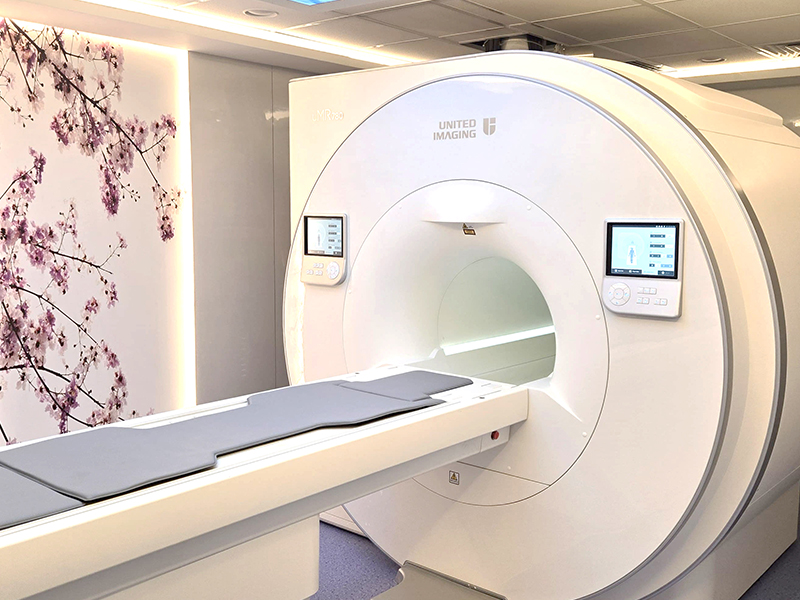
Magnetic Resonance Imaging, or MRI, uses magnetic waves to create detailed pictures of the body’s internal organs and tissues. These scans are especially useful for imaging the brain as they provide detailed information about its structure. The level of details provided by this scan is extraordinary compared to any other imaging modality. It is the method of choice for the diagnosis of many types of injuries and conditions because of its ability to tailor the exam to the particular medical question being asked.
An MRI scan can be used to examine almost any body part including:
- Brain and spinal cord
- Bones and joints
- Breasts
- The liver, womb and prostate gland
- Heart
- Blood vessels
How does it work?
MRI scanners are large cylindrical-shaped magnetic tubes. The working methodology goes like this: the scanner uses powerful magnets, radio waves, and a computer to create highly detailed images. During the process the atoms are knocked out of their original position and align in the same direction. The atoms return to their position after the radio waves are turned off. They then send back signals which are captured by a computer. These signals are then converted into images.
Preparations
Before the scan:
Unless advised otherwise, the patient can eat, drink and take medications as usual, on the day of the MRI scan. Due to the use of a strong magnetic field, the patient may be required to remove any metal objects on the body before undertaking the scan. This is because even small amounts of any metal can distort the MRI images.
Are there any risks from the procedure?
An MRI is an extremely safe procedure. It does not use X-rays, instead it makes use of a very powerful magnetic field. However, if you have any small pieces of metal inside your body, there is a risk that these may move or heat up during an MRI scan.
Contact the MRI technologist if you have:
* History of metal fragments in your eye
* Pacemaker or replacement valves of any kind
* Metallic clip on an artery or any implant
* Implanted port, an infusion catheter, an intrauterine device (IUD), any metal plates, clips, pins, screws, or surgical staples, a prosthetic hip, or any implanted metal object in your body
* Surgical staples, clips, plates, pins, and screws
* Tooth fillings or braces
To know “MRI scan price” or “MRI scan cost” do an online search to know the best diagnostic facilities in your area.
During the scan:
Inside the scanning facility, you will need to lie flat on the MRI scanner table. The table is controlled by a radiographer and you’ll be slowly move in and out of the scanner, which is open at both ends. You’ll be moved into the scanner either head first or feet first, depending on which part of the body is being scanned. On average, the scan gets completed within 15 to 90 minutes, depending on how many images need to be taken.
Contrast MRI
To get more clarity in images (tumours, certain tissues, inflammation and blood vessels), a contrast agent, typically gadolinium, may be used. It only occurs once your doctor orders and approves it. After the completion of the exam, either the body absorbs the contrast material, or it gets eliminated through urine. It needs to be remembered that not every MRI needs a contrast agent.
Advantages of MRI
* No use of ionising radiation: Unlike CT scans, ionising radiation is not used in MRI scans.
* Image acquisition in multiple planes (axial, sagittal, coronal, or oblique) without repositioning the patient.
* MRI scans have an edge for superior soft-tissue contrast compared to CT scans. This makes it suitable for evaluating disorders of the brain, spine, joints, and other soft tissue body parts
To know the best diagnostic centres available in your vicinity, do an online search with keywords “MRI scan near me.”
Disclaimer: For personalised advice and further information, always consult your doctor or qualified healthcare professional.
 Active Life Health Blog